Utility-scale & C&I storage modelling
Bid-grade BESS and PV + BESS studies, from cell to point of interconnection
Ampyra ESM provides independent sizing, degradation, dispatch and cost studies for utility-scale and commercial & industrial (C&I) storage and hybrid plants, built on the data OEMs actually provide and tested against your contract at the POI.
Every loss stage is modelled through every year of plant life.
Segments
From grid-scale tenders to factory rooftops
Utility-scale
Grid-scale BESS and hybrid IPPs
- Storage tenders with POI capacity, cycle and availability guarantees
- Hybrid PV + BESS and PV + wind + BESS plants, incl. round-the-clock supply
- Contracted capacity (SSA) and augmentation strategy over the term
Commercial & industrial (C&I)
Behind-the-meter PV + BESS
- Factories, logistics hubs, malls, hotels and data centres
- Peak shaving, time-of-use shifting and solar self-consumption
- BESS sizing against the site load profile and tariff, with lifetime savings
Services
Modelling and advisory for storage bids and projects
For developers, IPPs, EPCs, lenders and C&I energy users planning or reviewing BESS and hybrid projects.
Bid sizing
BESS sizing & capacity guarantee
- PCS and container quantities that pass the POI test every year
- BoL overbuild vs augmentation
- Yearly energy, RTE and aux at the POI
Procurement
OEM offer evaluation
- Like-for-like comparison of OEM offers
- Containers offered vs needed, margins
- Ranking by installed MWh or LCOS
Contract strategy
Augmentation & SSA optimisation
- When and how much to augment
- Contracted capacity milestones, hold-at-Max periods
- Lowest-LCOS strategy over the term
Hybrid design
PV + BESS configuration
- AC, LVAC, DC, Reverse DC and Dual DC coupling
- Clipping loss optimisation
- Tracker vs fixed PV, partial BESS coupling
Firm supply
Round-the-clock (RTC) studies
- PV, wind and BESS mix against CUF targets
- Lowest-LCOE plant sizing
- Time-of-use tariff value
Review
Technical due diligence
- Independent check of bidder or OEM sizing
- Degradation, RTE and aux assumptions
- Hot-climate performance at 50 °C
Simulation studies
Types of simulation we run
| Study | What it covers | Typical question |
|---|---|---|
| Standalone BESS | Daily cycles, grid-operator time series or contracted monthly cycles | How many containers pass the capacity test in every year? |
| C&I behind-the-meter | Site load profile, rooftop or ground PV, time-of-use tariff | What BESS size gives the best savings for this site? |
| Hybrid PV + BESS | Five coupling topologies, shared converters, POI export limits | Which coupling gives the lowest LCOE and least curtailment? |
| PV + wind + BESS (RTC) | Firm flat supply against annual CUF targets, with grid top-up | What PV, wind and BESS mix meets the CUF at least cost? |
| Contracted capacity (SSA) | Min / Max MWh milestones tested at the start or end of each year | How long should we hold the maximum contracted capacity? |
| Phased build (ICOD) | Up to three interim periods before COD on real dates | How aged is the battery at COD, and does each phase pass? |
| Sensitivity studies | Ambient profile, OEM, augmentation plan, coupling, PV design, cycles per month | How robust is the result to the main assumptions? |
Our in-house tool
A robust, customisable simulation engine behind every study
Every study is run on our own simulation tool, so models adapt to the tender rather than the tender being forced into a generic model.
Robust
Energy balance and results checked at every release, from cell to POI.
Customisable
Tender-specific test rules, dispatch and contract terms added as needed.
Fast
Dozens of options compared side by side in a single study.
Deliverables
Clear results you can put in a bid
Study report
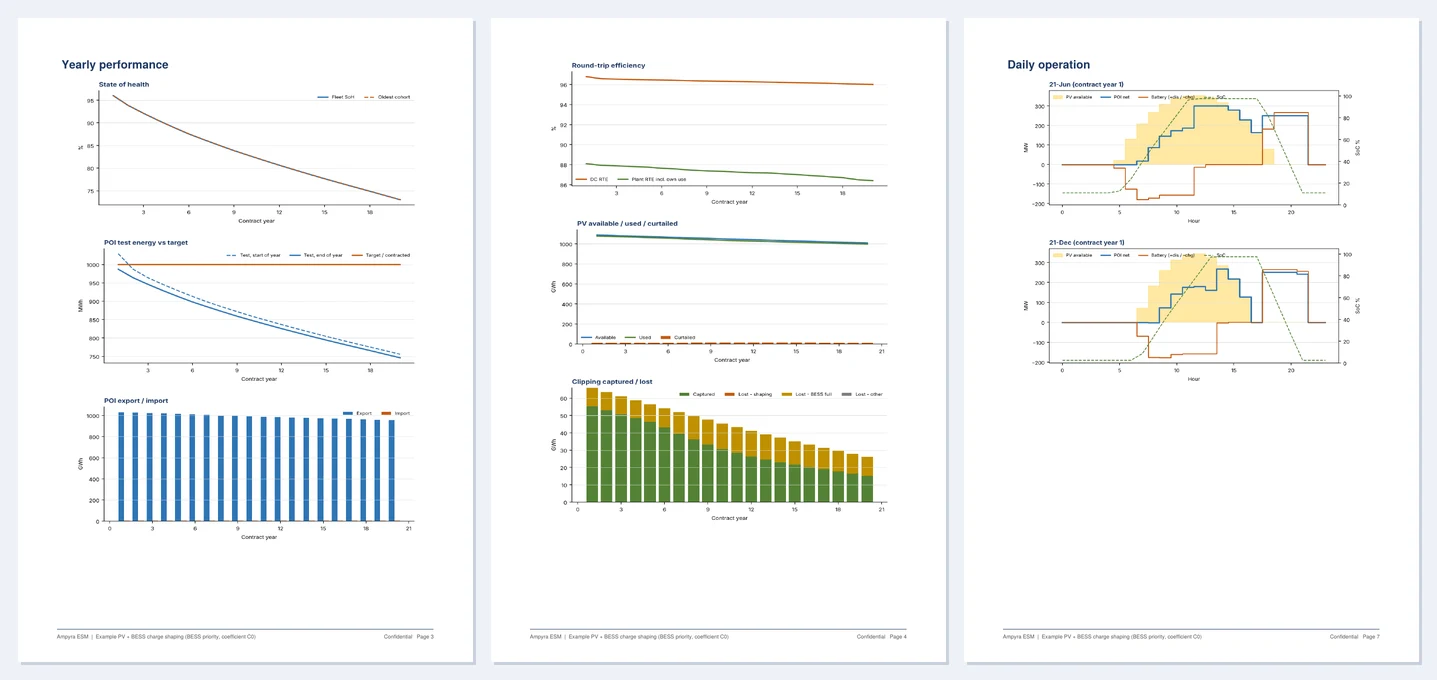
A client-ready report with your branding: key results, yearly performance, losses and costs.
Traceable workbook
Every input and yearly result in Excel, so your team can check each number.
Option comparison
OEMs, couplings or strategies side by side, with a clear recommendation.
Approach
How a study runs
Brief
Tender or contract terms, POI requirements and the decision to support.
Data
OEM datasheets and warranty curves, PV and wind profiles, site climate.
Model & compare
Sizing, degradation and dispatch over full life, with the options that matter.
Report
Results, sensitivities and a recommendation, reviewed with your team.
Built on OEM data
Studies use the container-level data OEMs actually share: degradation by P-rate, DC RTE by year, PCS and transformer efficiency, aux tables.
Tested at the POI
Guarantees are measured at the point of interconnection, so the contracted capacity is tested there in every year of life.
Transparent
A documented method with every assumption stated. Results depend on the OEM and site data supplied.
Contact
Let’s model your next utility-scale or C&I storage project
Share your tender requirements and OEM data, and we’ll scope the study with you.